
The Smart Apocalypse
Is intelligence an unearned privilege?

Mr. Jones asked me to stay after class.
Getting yelled at by teachers was nothing new to me at that time. A few years prior I had been a star pupil and a teacher’s pet, but puberty and a near-fatal dose of bullying had turned me into a teenage cynic. I had dropped my AP classes and was ditching school at least once a week. I was also earning a reputation for making acerbic comments in class, which a few teachers found funny, but most did not appreciate. Still, I managed to get A’s and B’s without much trying.
Mr. Jones’ complaint stuck in my mind like a splinter. I had made a sarcastic observation about how easy the class was after sailing through another test without studying. He wasn’t angry at me for being disrespectful, but rather for the fact that I had hurt my classmates. He told me that my sarcasm was discouraging to other students, many of whom had “worked their asses off” to get the same grade as me. He said, “It’s easy for you” and then told me something I hadn’t heard before – that I had been taking for granted the gift I had been given and the advantages it gave me. He noted that I was only taking this class because I was lazy and that while I had received a high grade, I hadn’t really earned it.
What he said angered me, not because he told me I was lazy – I knew that was true, but rather the claim that my intelligence was an unearned privilege. At that time, I had very low self-esteem but the one thing I was proud of was my intelligence. It was what made me special and the idea that it was just a matter of genetic luck somehow diminished me. To think that my fellow classmates, the same sort of people who had bullied me in the past, were actually the disadvantaged was absurd!
You see, I had been raised with the blank slate idea of human talents which claimed that talent was not the result of genes, but rather conditioning, and that anyone could do anything with enough practice (10,000 hours to be precise). Any gifts I had therefore must have been the result of my parents placing a high value on education and the grit and determination I had put into getting top grades.
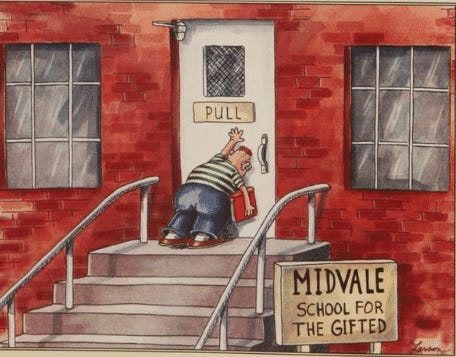
After high school, I made a half-hearted attempt at college but quickly dropped out to work in tech. My first full-time job was working on the helpdesk for an internet provider. The gaps in cognitive abilities I saw at my middle-class suburban high school were nothing compared to working with the public at large. I realized I had been raised in a bubble. On the helpdesk, we often had to deal with customers that seemed barely able to function in modern society - people that were unable to follow basic instructions or retain any information we told them. After a while though I started to get the nagging feeling that maybe there was nothing wrong with these people and they were just unlucky. It was easy for me but not for them, and it wasn’t their fault.
Eventually, my sentence on the helpdesk ended and I went to work for an IT department at a newspaper. I assumed working with smarter people instead of the general public would be a sort of paradise. Within a few months, my belief in the sanctity of smart people was severely challenged. Working with journalists was an enlightening experience. There were some amazing people, but I found many to be arrogant and self-centered. It was frustrating to me that such people were the gatekeepers that millions of people got their news on the world through.
I also learned there that while dumb people might believe stupid bullshit, smart people tend to believe sophisticated bullshit. People with higher intelligence are excellent at building castles in the sky – complicated theories and sophistry to support the beliefs that they want to be true. This is doubly true for those with high verbal abilities. They are excellent at getting society to bend to their will, as their opponents can’t match their skills in conjuring convincing arguments out of thin air.
After five years, I had seen enough of that world and decided to leave. I took a short-term job with a construction company to modernize their computer systems, but it ended up lasting several years as the company rapidly grew.
Unlike the newspaper, within a few months of working at the construction company I found that I really enjoyed working with those guys. They were mostly good-natured, generous and often hilarious. When they had a problem, they clearly communicated it (usually with creative swearing), which was a relief since I had gotten used to the fake politeness and backstabbing at the newspaper.
At the newspaper, people were theoretically nice. They had egalitarian beliefs and voted for progressive social policies to help the less fortunate. At the construction company, the people were actually nice. They didn’t have college degrees or the correct beliefs but were actually doing things with their time to help the unfortunate, such as building houses at Habitat for Humanity or volunteering at disaster sites. When Hurricane Katrina hit, several of the guys volunteered to go to Louisiana to help rebuild and stayed there for weeks, expenses paid by the owner of the company, himself a very generous man.
Things were going great until the financial crisis. Our contracts to build new schools vanished with the real estate bubble. Many of my coworkers lost their jobs. Some lost a good portion of their life savings.
Smart people in the government and the banking industry encouraged the lowering of lending standards in order to increase minority and first-time homeownership, which set off a buying spree. Other smart people, taking advantage of a lack of government oversight, packaged these subprime mortgages into bundles and resold them as AAA rated securities to investors. A third group of smart people assured a nervous public that there was no housing bubble and there was nothing to worry about. It all came crashing down when the people who should never have been given home loans suddenly couldn’t pay for them and those securities became worthless.
Mocking Americans for being stupid was a cultural touchstone during this time, prompted mostly by the Iraq war and conservative support for George W Bush. Jon Stewart was eviscerating politicians and pundits every day with his smug takedowns. Musicians released hits songs such as American Idiot and movies such as Borat routinely made fun of the gullibility of the American public.
I began to notice a strange contradiction in our society. We are constantly receiving social signals about how important it is to be smart and how bad it was to be stupid, but what smartness is and how to get it is never clearly defined. Was it innate? Something that increased with education and experience? The lack of public discussion about a topic so important seemed odd.
By that time, I had personally I lost all faith in the belief that cognitive abilities or education made any difference to the dignity or quality of a human soul, and I no longer held the naïve belief that stupid people were the cause of bad policies in America.
I didn’t really think much on the topic for a few years until Nicholas Wade, a former science reporter at the New York Times, published his book on race; A Troublesome Inheritance. The belief made popular at the end of the last century was that modern humans came from a single ancestral tribe that lived around 200,000 years ago in Africa, and there hasn’t been any significant evolution since then. When humans left Africa and began to populate the rest of the planet, environmental differences caused some minor genetic changes, such as skin color and lactose tolerance, but these differences between population groups were minor compared to the genetic diversity within groups.

Wade’s book broke the news that recent genetic findings do not support that theory. Evolution has been recent, copious and regional. According one estimate, at least 8% of the human genome has been under recent selection pressure. Since the book came out in 2014, a number of additional discoveries have been made about the amazing history of our diverse human family. It now appears that modern humans came from at least two stem populations in Africa and that humans interbred with Neanderthals after leaving Africa.
Wade’s book also discussed (somewhat speculatively) that recent evolutionary changes may affect the types of societies that humans create, and that there is a co-evolution of genes and culture caused by environmental differences. This lead me down to the path to reading up on human intelligence research.
If you read an introductory book on intelligence research, you’ll quickly learn that what is known in the field is often radically different than what the public is lead to believe. Intelligence is highly heritable. Intelligence is not very difficult to measure. It is generally believed that IQ tests are fair and not culturally biased. There are large and persistent IQ gaps between different population groups, and the question of how much of that gap is caused by genetics has been hotly debated for decades.
Intelligence researchers have written extensively on how and why the public is so often misled about the nature of intelligence, usually blaming the press and other academics for misinformation. Theories about the cause of this misinformation generally focus on the horrors of the past (slavery, eugenics and the holocaust) and how they have inoculated intellectuals against genetic explanations for human differences. It is also posited that the highly educated tend to have progressive egalitarian worldviews, and because this information doesn’t align with how they want to see the world they either ignore it for fight against it. In additional, activist public intellectuals such as Stephen J Gould sold a willing public on beliefs that were based less on science than egalitarian hopes and dreams.
These explanations have their merit, but I think they are too kind for assuming good intentions. Throughout human history, the powerful have sought to mystify the source of their power, whether it be through religion, divine mandate or royal inheritance. The current mystification of the nature of intelligence clearly benefits the cognitive elite. It allows these people to envision themselves as pursuing social justice and equality while at the same time not allowing any public discourse on a major source of their privilege. Admitting the unearned advantage of intelligence might challenge their social standing, especially for those who claim their identity as a minority made them more disadvantaged than the majority.
As the old saying goes, we can deny reality but we cannot deny the consequences of denying reality. Those consequences are now tearing at the social fabric of the United States and other Western nations. The second half of the last century was full of promises that we would soon be a post-racial society, with no one noticing or caring about race and all groups being generally equal in average incomes. That obviously didn’t happen, and numerous social interventions to make it happen have failed. Thinking on the topic of inequality was forced to evolve. If these interventions failed, the thinking goes, then surely America must have such severe systemic inequities that even if people are treated equally there will never be equal outcomes.
After the 2020 “racial reckoning” we saw the rapid increase in new social policies based on this logic. Racial equity was now to become a chief aim of the government and corporations. In education, we saw that dropping of standardized tests for college entrance, the end of meritocracy at some schools for gifted students, and the dropping of advanced subjects in high schools – all due to racial equity concerns. In corporate America, DEI training grew into a multi-billion dollar industry. In the culture we saw the new practice of capitalizing Black but not white in news articles, movies and television shows now routinely race-swap historic figures and sometimes outright lie about history. In the government, there is a move to make racial equity a primary mission of many departments and even the Federal Reserve.
The side effects of these new policies are already causing alarm and there are predictions of a widescale competency crisis in America. The cognitively gifted have suddenly found their opportunities more limited if they are White or Asian and there growing anger at system that many now see as unfairly discriminating against them.
As if all this wasn’t bad enough, a black swan event is unfolding that is going to lower the market value of intelligence even further and eliminate more opportunities – breakthroughs in artificial intelligence. Intellectual occupations such a writers and lawyers, who never had to worry about their job being shipped overseas or having to compete with cheap immigrant labor, are now worried about being replaced with AI. Within the next few years there likely will be a deluge of college educated people losing their jobs.
The AI revolution is often compared to the invention of the printing press as a civilization altering event. I think a more apt comparison would be the introduction of mass-produced firearms such as the Colt Peacemaker into the lawless American frontier. Before cheap firearms, your ability to win a physical conformation was determined by your natural talents and training. Afterwards, anyone that could purchase a gun could beat the strongest and meanest opponent. It evened the playing field between contestants and physical combat ability lost its advantage in daily life. To this day, gun ownership in America is often seen as an equalizer and a defense against tyranny.
Research on the affects of AI on the workforce have just started, but preliminary data shows what a growing number of people have been noticing themselves - AI is excellent at helping complete tasks if your ability or knowledge of how to do that task is somewhat lacking. In one study, deploying AI technology increased the productivity of low performing workers by 43%, while only slightly increasing the productivity of high performing workers.
If you are an expert at completing a task, AI assistance may not be much help. For example, if I am completing a new project with technology I’m familiar with, I don’t need to use AI. However, if this is new technology I am not familiar with, AI is a great help at recommending next steps and checking my work, thus greatly enhancing my skill level.

Billions of people around the world will soon have access to this new equalizing AI technology, greatly amplifying their existing talents. What will the world look like when all the unwashed masses each have their own 130+ IQ assistant in their pocket to help them with daily tasks? What will the cognitively gifted do when their intelligence no longer guarantees them a comfortable life and they suddenly must compete against the same people who were mowing their lawns and cleaning their houses, who are now armed with AI?
The last few centuries have seen more social reforms in the name of equality than any other time in human history. The foundation of these reforms is the moral belief that all people should be treated equally, but the reasons for that belief have evolved over time. As our society became more secular, we could no longer claim that people should be treated equally because we are all equal before God or because the creator endowed us with natural rights. The reason for equality then changed to the claim that people should be treated equally because they are actually biologically equal in all socially desirable traits, and to discriminate against equals is an injustice. This dubious claim has been maintained by a veil of willful ignorance – one that can’t be maintained much longer, now that social and government policies are mandating equal representation based on race.
Now is the time to embrace the idea that all humans deserve equal treatment and dignity due to the simple fact that they are humans and abandon the idea that the value of people lies in their attributes, especially when those attributes are about to become much less valuable in the marketplace.